A Winter Morning by the Garage That Got Me Thinking
The idea for this whole setup started on one of those chilly December mornings here in Duluth. You know the kind I mean. The sky is still dark when you wake up, and when you finally pull up the blinds, the snow along the driveway has that faint blue tint from the weak early light. The air has a bite to it, and if the wind happens to be coming off Lake Superior, it cuts right through your jacket a little more than you expect.
I had just poured my first cup of coffee and stepped out to see how bad the driveway looked after the latest dusting of snow. The neighborhood was quiet, just a couple of cars warming up down the block, exhaust drifting sideways in the cold. The pine trees behind the house were still, and you could hear that soft hush that only happens when the snow is fresh.
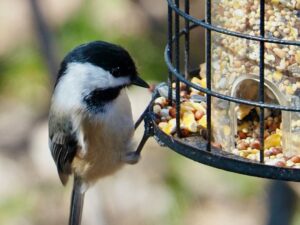
As I stood there at the edge of the garage, sipping my coffee and deciding whether I had enough energy to shovel right away or stall for a bit, a chickadee zipped past me and landed on the corner of the old feeder out in the backyard. The thing was half buried behind a drift, hanging on a pole I had to reach by walking across the yard. I watched that little bird peck at the last bits of seed, then fly off in a hurry.
I remember thinking, “You know, I’m not getting any younger. Walking across that icy yard with a heavy bag of seed isn’t the smartest move.” My knees have plenty to say about that sort of thing these days. I could feel my boots slipping just a little on the packed snow near the driveway, and I thought, there has to be a better way to keep the birds fed without risking a fall every time I go out there.
That’s when the side of the garage caught my eye. The wall runs right along the driveway, close enough that I can reach it without stepping off the clear pavement. I started to picture a feeder hanging there, where I could pull the car in, pop the trunk, and pour seed without trudging through snowbanks. The birds would still find it just fine. They’re better at figuring things out than I am half the time.
The Problem With My Old Feeder Setup
For years, I kept my main feeder way out in the backyard. That’s what you see in all the pretty magazine pictures, right? A feeder hanging from a shepherd’s hook in the middle of a snowy yard, surrounded by trees and bushes. It looks nice, I’ll give it that.
When I was younger, it wasn’t a big deal to haul a bag of seed out there, even in winter. I’d crunch across the snow, sink in a bit, balance the bag on my hip, and refill everything. My back might complain, but it bounced back pretty fast.
These days, things are different. At 68, my balance isn’t quite what it used to be. My knees are a little stiff on cold mornings. My lower back can get sore if I carry too much weight. You get the idea. The walk from the back door to that old feeder started to feel longer than it used to, especially after we’d had a thaw and refreeze and the snow turned into uneven, lumpy ice.
A couple of winters ago, I nearly went down. I had a scoop of seed in my hand, stepped wrong into a shallow hole where the snow had melted, and my boot slipped. I caught myself, but the seed flew everywhere, and I stood there thinking, “Well, Jeremy, that could have ended in a broken hip.” I guess that’s the kind of thing you start to think about more as you get older.
There were other little annoyances too:
-
The seed bags stayed in the garage, so I had to carry scoops back and forth.
-
When it was really cold, my fingers got numb by the time I finished.
-
If the wind picked up, it felt like it was blowing straight across the yard, right into my face.
I still loved the birds. The chickadees, the nuthatches, the juncos hopping around under the feeder, the occasional blue jay shouting from the pine tree—that part was still worth it. I just needed some way to make the “keeping them fed” part easier on my body.
Standing by the garage that morning, coffee in hand, I realized my life might be simpler if I brought the feeder closer to where the seed already was: the driveway and the side of the garage.
Figuring Out a Safer, Easier Spot by the Garage
I didn’t move anything that day. I just stood there, looking at that bare wall along the garage, thinking it over. The sun was coming up behind a thin sheet of clouds, making the sky look like frosted glass. A crow flew over, calling out in that rough voice they have, and disappeared behind the rooftops down the block.
“Could the birds really be happy here along the driveway?” I wondered. It didn’t look like the picture-perfect “backyard nature scene.” It was just a plain wall, some snowbanks pushed up along the edges, and the smell of cold concrete.
But when I held still and just watched for a while, I noticed a few things:
-
The wind from the lake is blocked a little by the garage, so that spot is calmer than the middle of the yard.
-
There’s a small pine tree near the corner of the house where birds already like to perch.
-
The driveway stays cleared and sanded, so I can walk there without worrying as much about slipping.
It started to make sense. The birds don’t care if something looks pretty to us. They care if it’s safe, if there’s food, and if there’s a place to fly to if they get spooked.
I started picturing a simple hanging feeder under the eaves near that pine tree, close enough that I could stand on the driveway, open the lid, and pour seed right from a small container. No more marching across the yard with a heavy scoop. No more wobbling on uneven snow.
The more I thought about it, the more it felt like one of those small, practical changes that fits life at this age. No big overhaul, just moving things to where they actually work for your body and your daily routine.
What I Actually Did: A Simple Hanging Feeder by the Garage
One afternoon, when the temperature warmed up a little and I could work with my hands without them turning into ice, I decided to make it happen. The sky was that pale winter blue, with a few wispy clouds drifting over the neighborhood. You could hear a distant snowblower somewhere, and the sound of a truck going down one of the main streets.
Here’s what I ended up doing, step by step:
-
Picked a good spot on the garage wall.
I chose a place under the eaves, about halfway between the garage door and the corner where the pine tree stands. This way the feeder is somewhat sheltered from snow and wind, and the birds have that tree as a nearby landing spot. -
Installed a simple metal bracket.
Nothing fancy. Just a sturdy hook meant for hanging a basket. I used a power drill and made sure to hit solid wood, not just siding. Even at my age, I can handle a drill if I take my time and use both hands. -
Chose an easy-to-fill hanging feeder.
I picked one with a wide opening at the top and a clear body so I can see how much seed is left. At this point in life, I don’t want to squint and guess. -
Set up a small “refill station” in the garage.
I keep the big bag of seed in a plastic bin inside the garage to keep mice out. Next to it, I have a lighter plastic pitcher that I use as my scoop. I just fill the pitcher, walk a few steps to the hanging feeder, and pour. -
Checked my footing.
I laid down a narrow strip of non-slip mat right where I stand to refill the feeder. When the driveway gets icy, that little strip keeps my boots from sliding.
The first time I filled the new feeder, I kind of smiled to myself. It was just so easy. I stepped out of the garage, took about three steps on clear pavement, reached up to the feeder without stretching, poured the seed in, and that was it. No snow in my boots, no juggling a heavy scoop, no tightness in my back.
How the Birds Responded
I’ll admit, I wondered if the birds would take to this new spot. They’re creatures of habit, after all. For the first couple of days, it was pretty quiet. A chickadee or two showed up at the old backyard feeder, which I still had hanging but wasn’t filling as often.
Then, one morning, I was backing the car out and saw a flash of movement by the garage. A chickadee had found the new feeder. It hopped around, grabbed a seed, and flew straight to the pine tree. A few minutes later, it came back, this time with another one behind it.
Within a week, the regulars had all figured it out:
-
Nuthatches scooting along the trunk and then over to the feeder.
-
Juncos and sparrows cleaning up what fell on the packed snow near the driveway edge.
I guess it reminded me that the birds are a lot more flexible than we sometimes give them credit for. As long as there’s food and a safe place to land, they’ll adapt.
Little Lessons I Picked Up Along the Way
Once this new setup became part of my routine, I started noticing the little benefits it brought to my days, especially in the dead of winter.
For one thing, I didn’t dread the refilling anymore. Honestly, with the old feeder, there were days I thought, “I should go out there,” and then talked myself out of it. The idea of slipping on the uneven snow or fighting with a frozen feeder just didn’t appeal to me. With the garage setup, it became something I could do almost without thinking. I’d grab the pitcher of seed on my way out to get the mail or before heading to the store.
Here are a few small lessons that might help other older folks thinking about a similar setup:
-
Keep things close to where you already walk. If you’re already out in the driveway clearing snow or getting in the car, having the feeder nearby makes it easy to keep it filled.
-
Use containers you can handle. I stopped trying to pour directly from heavy bags. A plastic pitcher with a handle is a lot kinder to my hands and shoulders.
-
Think about shelter. The side of the garage blocks some of the wind. That helps the birds and makes it a little more pleasant for me when I’m standing there, too.
-
Give the birds some nearby cover. That pine tree by the corner of the house turned out to be a perfect place for them to land and feel safe.
A Simple “Garage Feeder” Checklist
If I had to put this into a little checklist for folks around my age, it might look like this:
-
Check your footing. Make sure the area where you’ll stand is clear, flat, and, if possible, treated with sand or covered with a non-slip mat.
-
Limit the distance. Try to keep the feeder within just a few steps of where you park the car or store the seed.
-
Pick a feeder that’s easy to open. Lids that pop up or twist off without much effort are your friend.
-
Use one main seed type. For me, black oil sunflower seed brings in plenty of birds without making things complicated.
-
Watch and adjust. If the birds seem hesitant at first, give them time. If you notice they’re nervous about a certain spot, move the feeder a foot or two and see if that helps.
These may sound like small things, but for someone in their late sixties or seventies, small things add up.
How This Small Change Affects My Days Now
These days, my routine feels pretty natural. I wake up, have my coffee, and glance out toward the side of the garage. If I see the feeder running low, I don’t think, “Oh boy, here we go again.” I just grab the pitcher, step out onto the driveway, and refill it while my breath fogs the air in front of me.
On very cold mornings, when the sky is still dim and the snow squeaks under my boots, there’s something comforting about hearing the faint calls of chickadees as they start to stir. The side of the garage catches just enough light as the sun creeps up behind the neighborhood, turning the frost on the feeder into tiny sparkles.
I’ve noticed my mood lifts a bit when I see the birds there, doing their thing. It’s not some big dramatic change. It’s more like a quiet assurance that, even in a long Duluth winter with short days and icy streets, life is still going on in these small ways.
There’s also a sense of independence in all this. At my age, you start to think about what you can still do on your own and what you might need help with. Being able to manage my bird feeders without asking someone else to come over and carry things for me feels pretty nice. It’s a small piece of my day that’s fully mine.
Why This Matters More to Me Now at My Age
To be honest with you, when I was younger, I probably would’ve just muscled through the awkward feeder setup in the backyard and not thought too much about it. Now, I pay more attention to how things feel on my knees, my back, and my balance.
Hanging a bird feeder by the garage, where I can refill it right from the driveway, might not sound like a big life event. But it fits the shape of my days now. It respects the fact that I move more slowly, that I’m more careful on ice, that my hands don’t grip heavy things quite as easily.
At 68, I find a lot of value in simple, repeatable habits that bring a little bit of joy without a lot of strain. Watching chickadees and nuthatches visit that feeder by the garage wall, with the smell of cold air and the faint sound of Lake Superior’s wind in the distance, gives me exactly that.
If you’re in a similar season of life, maybe in a place with long winters and quiet streets like we have here, you might want to try something along these lines. You don’t need a big yard or fancy gear. A plain garage wall, a safe driveway, a simple hanging feeder, and a manageable way to pour the seed can be enough.
You might find, like I did, that this small setup turns into a steady, gentle rhythm in your days. As the winters roll by and the springs take their time arriving, those little birds by the garage can keep you company in a way that’s not too fussy, not too hard on the body, and pretty nice for the heart, you know what I mean.