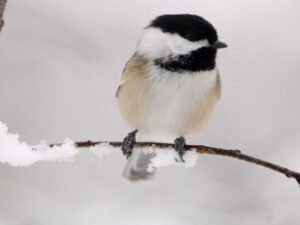

A Cool Duluth Morning When the Birds Looked Just a Little Too Far Away
One cool spring morning here in Duluth, I was standing out on my small back porch with a mug of coffee, watching the day slowly wake up. The sky had that washed-out blue look, like it hadn’t had its first cup yet either. There was still a little snow tucked into the shady corner by the fence, even though it was supposed to be spring. That’s Duluth for you. The air felt damp and just a little sharp, and I could tell from the feel of it that the wind was drifting in off Lake Superior, even if I couldn’t see the water from my place.
The pine tree in the back was holding a handful of birds already. I could hear the chickadees doing their usual “chick-a-dee-dee-dee,” and there was a different song in there too that I couldn’t quite place. It sounded sweet and clear, with a little rising note at the end, and it made me curious. The trouble was, the bird itself was far enough away that all I could really see was a small shape among the needles. Just a little moving bump in a green blur.
I squinted, leaned forward, even tried tilting my head like that would magically sharpen things up. My eyes did what they could, but at sixty-eight, they’re not exactly the high-performance model they used to be, you know what I mean.
I stood there thinking, “I’d really like to see that bird better, without turning this into a whole production.” I didn’t want to dig out my old, heavy binoculars from the hall closet. I knew if I did, I’d be fussing with straps and adjusting both sides, and my hands would probably wobble a bit like they do these days. I just wanted something simple I could hold in one hand, steady enough to get a close look without feeling like I was wrestling with equipment.
That was the moment I realized I needed to rethink how I was watching birds. Not out on a mountain trail or miles into a forest, just right here: from my porch, from my backyard, from a park bench, or through the kitchen window on days when the wind is a little too sharp.
And for that, I started wondering if there was a better tool for an older guy with slower hands and a softer schedule.
My First Tries with Binoculars and Why They Didn’t Quite Fit My Life Anymore
Like a lot of folks, I started out with plain old binoculars. I had an old pair from years back that I used to take on fishing trips and the occasional hike. When I first got more interested in watching birds around the house, I thought, “Well, these will do just fine.”
I remember taking them down to one of the small neighborhood parks near my place on an early summer morning. The grass was still damp, and there was that earthy smell from the soil waking up. The air felt pretty nice—cool, but not bone-chilling like our winters. I found a bench under some tall pines, settled in, and lifted the binoculars.
For the first few minutes, it was exciting. I could see every little movement in the branches, the tiny head tilt of a chickadee, the way a nuthatch crept down the trunk like it hadn’t heard of gravity. But after a while, the magic started fading into discomfort.
A few things happened:
-
My hands started to shake just a little bit. Not a lot, just that older-person tremble some of us get.
-
Holding both barrels of the binoculars up in front of my face got tiring.
-
The strap around my neck pulled in a way that made my shoulders feel tight.
I found myself constantly shifting, putting them down, picking them back up, trying to refocus. It started feeling like more work than I wanted for a quiet morning in the park.
At home it wasn’t much better. Standing on the porch with the binoculars, I’d be trying to keep both sides lined up with my eyes while my hands reminded me they weren’t as steady as they used to be. Sometimes I’d just give up and watch with my bare eyes, even if that meant missing some of the detail.
I guess I had this picture of myself as the kind of birdwatcher who always had binoculars around his neck, ready to go. But the truth is, at my age and with my joints and hands the way they are, that setup didn’t really fit my life anymore. It felt like I was trying to squeeze myself into a younger person’s hobby instead of shaping it to the person I am now.
The Day I First Tried a Small Monocular
The idea of using something lighter and simpler showed up in my life through my nephew, of all people. He came up to visit one fall, right around the time when the leaves were turning and the air had that mix of wood smoke and cold in it. We were sitting on the back porch, both of us wrapped up in jackets, watching the pine tree and the feeder.
I was doing my usual thing—squinting, leaning forward, muttering, “What bird is that now?”—when he reached into his pocket and pulled out this little tube-shaped thing.
“Here, Uncle,” he said. “Try this.”
It was a small monocular, something he used for hiking and ball games. It fit right in his palm. No strap, no folding sides, just one tube and a focus ring. He explained that you just look through it with one eye, like a tiny telescope.
I lifted it up—carefully, because I’m not as smooth with new gadgets as I used to be—and held it in front of my right eye.
The first thing I noticed was the lightness. It didn’t feel like much in my hand at all. Just a little bit of weight, enough that I could feel I was holding something, but not enough to make my arm complain right away.
I turned it toward the pine tree and moved the focus ring a bit. The needles came into sharp view, then blurred again, then came back into focus as I slowly found the right spot. It took a minute, but once I got it, there was the bird: a chickadee, clear as day, with that little black cap and a glint in its eye.
I remember saying, “Well, I’ll be,” mostly to myself.
What struck me most was that I could do it with one hand. My left hand rested on the porch railing, my body relaxed. Only my right hand was holding the little scope. I didn’t have to balance two barrels or fuss with a strap. It felt, I don’t know, more natural somehow. More suited to someone who doesn’t want to fight their own equipment.
When my nephew left, he told me to keep it for a while and see if I liked it. I took him up on it. Over the next few weeks, I tried it out from the kitchen window, the front step, and a couple of quiet spots in the little parks around my neighborhood.
Pretty quickly, I realized this style of glass matched the way I live now a lot better than those old heavy binoculars.
Little Lessons I Learned About Keeping One-Handed Viewing Steady
Now, I should say this: just because something is lighter doesn’t mean it’s automatically easy to hold steady. My hands have that little bit of shake in them no matter what I’m holding. So I had to learn some tricks to keep the view calm enough to enjoy.
Over time, I started figuring out what helped me the most.
Grip and Size Matter More Than You’d Think
I tried a couple of different shapes. One was longer and slimmer, almost like a small flashlight. The other was shorter and a bit thicker.
Surprisingly, the shorter, slightly chunky one felt more stable in my hand. I could wrap my fingers around it, and it filled my palm just enough that I didn’t feel like I was pinching it.
For my hands, a few things made a difference:
-
A rubbery, non-slip surface so it didn’t feel like it would slide.
-
Enough thickness that my fingers had something solid to hold.
-
Not so long that it felt like a lever wobbling around out there.
I guess you could say I was looking for that “coffee mug feel.” If it felt about as secure as holding my mug in the morning, that was about right.
Using My Body as a Tripod
One of the best tips I stumbled into—maybe by accident—was using my body as extra support.
Instead of standing straight and holding the monocular out in front of me with my arm fully extended, I started doing things like:
-
Tucking my elbow gently against my chest.
-
Resting the side of my hand against my cheek.
-
Leaning my shoulder or upper arm lightly on the doorframe or window frame.
Doing that turned my arm from a wobbly stick into more of a solid base. The shaking didn’t disappear, but it got calm enough that I could follow a bird as it hopped along a branch.
From the kitchen window, I sometimes rest my forearm on the window sill. On the porch, I use the railing. Sitting on a park bench, I might put my elbow on the armrest. Little adjustments like that make a big difference when your muscles don’t fire quite as steadily as they used to.
Picking a Calm Magnification
I’m not a technical guy, so I won’t throw numbers around too much here. I just know this: if the image is too “zoomed in,” every little shake looks like an earthquake.
One of the monoculars I tried made things look closer than I really needed. It was impressive at first, but the view bounced around whenever my hand trembled. Another one was a bit less powerful, and strangely enough, I liked it more.
For me, something in the moderate range works best—close enough that I can see markings and behavior, but not so strong that it magnifies every twitch of my fingers. It’s a bit like choosing the right TV volume: too loud, and it’s tiring; too soft, and you miss things. There’s a comfortable middle.
Breathing Slower Helps, Too
This one surprised me. I noticed that whenever I held my breath to “steady” my hand, the view sometimes got worse. My chest would tighten, my arm would tense up, and that tension would show up as more wobble.
So I started doing the opposite:
-
Taking a slow breath in.
-
Letting it out gently.
-
Looking through the monocular while I was breathing steady, not holding everything rigid.
It’s kind of like the way I drink coffee now. I don’t gulp it down like I did when I was running late for work years ago. I just take small, relaxed sips. Same idea here. The more relaxed I am, the steadier my view seems to be.
Trying Different Spots: Backyard, Window, and Neighborhood Parks
Once I had a feel for this small, one-handed way of seeing birds up close, I started testing it in different places.
From the Kitchen Window
On cold or windy days—especially when that sharp wind is coming in off the lake—I stay inside and watch from the kitchen. The feeder is close enough that I don’t really need any help, but the monocular lets me pick out details I’d otherwise miss, like small patterns on wings or a glint in the eye.
I keep the thing sitting right on the counter by the window, next to the coffee maker. That way:
-
I don’t have to go hunting for it.
-
I can grab it with one hand while the other holds my mug or rests on the counter.
-
I’m more likely to actually use it, because it’s easy.
One small change I made was to move the feeder just a little closer and more in line with where I naturally stand. That way I don’t have to twist my body or crane my neck. It’s a straight, comfortable view, and the monocular just adds a little extra clarity when I want it.
That small adjustment—bringing the feeder more in front of the window—made the whole experience easier on my body. I caught myself spending more minutes, and then tens of minutes, just watching without feeling strained.
On the Porch with a Chair
When the weather is friendlier—those bright summer mornings, or cool but sunny days in late spring—I like to sit out on the porch. The street is quiet at that hour, just a car now and then, maybe someone walking a dog on the sidewalk. The air smells a bit like pine from the trees at the end of the block.
Out there, I usually sit in a sturdy chair with arms. I rest my elbows on the arms of the chair and bring the monocular up to one eye. That way the weight is supported, and my hands don’t have to work as hard.
Sometimes I’ll watch the feeder. Other times, I’ll slowly scan the pine tree and the sky above. On certain mornings, if the clouds are just right and the light is coming in from a low angle, you can catch a gull or crow passing overhead, heading toward the lake. It’s a simple thing, but it feels pretty nice to see that with a little extra clarity.
A Bench in the Park
There’s a small park a few blocks over with tall pines and a loop of sidewalk that folks around here use for short walks. On days when my legs feel up to it, I’ll wander over there, walking slowly past the quiet houses and listening for bits of birdsong mixed in with the distant traffic.
I usually bring the monocular in my jacket pocket. Sitting on a bench, I can rest my elbow on the armrest or even on my knee if I feel limber enough. From there, I don’t go chasing birds around the park. I just pick one patch of trees and let whatever wants to show up, show up.
Sometimes I see a woodpecker working a trunk, or a nuthatch hopping down in that odd upside-down way they have. Sometimes I just see branches moving in the wind and feel glad to be outside in the fresh air, even if I’m not identifying anything special.
The nice thing is, the small scope doesn’t feel like gear I have to manage. It’s just there when I need it, like a pair of reading glasses for the trees.
One Small Change That Surprised Me: Wearing It on a Simple Wrist Strap
For a while, I kept the monocular either in my pocket or on the table. That worked, but there were times outside when I got nervous about dropping it. My fingers aren’t as quick as they used to be, and occasionally I fumble things.
One afternoon, I was at a little outdoor store in town, just looking around more than anything else. I saw a bin of simple wrist straps meant for small cameras and such. It got me thinking.
I bought one, brought it home, and managed to attach it to the little loop on the monocular. Now, when I’m using it outside, I slip the strap over my wrist first.
What changed:
-
I felt less afraid of dropping the monocular off the porch or into the snow.
-
That let my hand relax a little bit more, which actually made the view steadier.
-
I started using it more often because it felt like less of a risk.
It’s funny how one little strap can change your comfort level. I guess it’s like wearing a seatbelt—you hope you never need it, but knowing it’s there lets you relax.
That small change improved my day-to-day birdwatching more than I expected. I don’t stand there thinking, “Careful, don’t drop it,” the whole time. I just watch.
A Simple Checklist for Folks Whose Hands Aren’t as Steady Anymore
I’m not trying to be an expert here, just an older guy sharing what’s worked out for him. If someone my age asked me what to look for when picking out a small, easy-to-hold scope for birds, this is about what I’d tell them.
What Feels Good in Your Hand
When you pick one up, ask yourself:
-
Does it feel light enough that your arm won’t get tired quickly?
-
Can you wrap your fingers around it comfortably?
-
Is the outside surface a little grippy, so it doesn’t feel slippery?
If it feels awkward or heavy in the store, it’s not going to magically feel better in your backyard.
How You’ll Hold It Steady
Think about where you’ll be using it:
-
At a window: can you rest your elbow on the sill or counter?
-
On a porch: can you lean on the railing or use a chair with arms?
-
In a park: can you sit on a bench and rest your arm on your knee?
You don’t need a whole tripod setup. Just a plan for how your body will help out your hand.
How Strong the View Needs to Be
Bigger isn’t always better.
-
If it makes things look very close, tiny shakes will look big.
-
A moderate “zoom” is often easier to live with.
-
Try to find a balance where you can see more detail without feeling like you’re on a bouncing boat.
If you can test it by looking at something across the store or out a window, you’ll get a feel for how jumpy the picture looks with your natural hand tremor.
Little Extras That Help
A few small add-ons can make life easier:
-
A wrist strap so you’re not worried about dropping it.
-
A simple cap or cover that’s easy to take on and off with older fingers.
-
Clear, easy-to-turn focus ring that doesn’t require a lot of force.
If the controls feel too stiff or fussy, that’s a sign it might annoy you later.
Why This Small Piece of Glass Fits My Life Now
There was a time in my life when I probably would have gone all-in on the latest gear—big binoculars, long lenses, maybe even a tripod and a backpack full of stuff. I don’t have that kind of energy or desire anymore.
These days, I find a lot of contentment in simpler things:
-
A slow morning with coffee at the kitchen window.
-
A quiet half hour on the porch, listening to the wind in the pine and the distant hum of the city waking up.
-
A short walk to a neighborhood park on a bright summer day, sitting on a bench and watching birds move through the branches.
Having a small, light scope I can hold in one hand fits into that kind of life. It doesn’t demand much from me. It doesn’t feel like a project. It’s just a tool that lets me see the world outside my little house in Duluth a bit more clearly, even as my eyes and hands start to show their age.
I think that’s the heart of it: at sixty-eight, I’m not trying to conquer anything. I’m not chasing records or building lists. I’m just trying to stay connected—to the seasons, to the birds, to the feel of this place I call home.
When I stand at the window on a cold morning and lift that small monocular to my eye, watching a chickadee puff itself up against the wind blowing in from Lake Superior, I feel like I’m still part of something bigger than my aches and pains. When I sit on a bench under tall pines in a quiet park and watch a woodpecker work, I feel steady, even if my hands aren’t.
If you’re a little older, like me, and your body doesn’t always cooperate, I’d say there’s no shame in choosing tools and routines that make life easier. You can look for something light enough to hold in one hand, steady enough with a little support from your body, and simple enough that you’ll actually use it.
At this stage, I’ve learned that making things gentler on myself doesn’t take away from the joy. It often adds to it. A clear view of a familiar bird in my little Duluth backyard, seen through a small piece of glass that doesn’t fight me—that feels pretty nice, you know what I mean.