A Quiet Winter Morning Here in Duluth That Got Me Thinking
Most mornings here in Duluth start the same way for me now. I shuffle into the kitchen while it’s still dark, put on a pot of coffee, and listen to the radiator click and knock as it wakes up. Out the window I can just make out the shape of the pine trees in the backyard, and once in a while, if the clouds are thin enough, I can see the faint glow over toward Lake Superior.
In December, the sun doesn’t hurry. The sky doesn’t really start to lighten until close to eight. So my “early sunrise coffee” these days is more like sitting with that first hot mug in the soft gray, watching the darkness slowly turn into shapes. The snow out back has that blue tint you only see in winter, and my breath hangs in the air when I finally open the back door.
One morning not long ago, I stepped out onto the small porch with my coffee in one hand and my other hand on the railing, moving a little carefully because the steps get slick. It was cold enough that the steam from my mug looked almost as thick as the fog that sometimes rolls up from the lake. I heard this tiny high-pitched call, just a couple of notes, and there on the feeder pole was a black-capped chickadee, already starting its day.
I remember thinking, “Well, you’re more awake than I am,” and I just stood there for a while, holding the coffee, watching that little bird hop around like the cold didn’t bother it at all. As I stood there, half sleepy and half awake, I realized I’d sort of fallen into a new habit without planning it: a quiet bit of birdwatching in the backyard, right after that first cup.
I’ll be honest with you, at my age my eyes aren’t what they used to be, and sometimes the birds just look like little moving shadows in that early light. I’ve had questions pop up in my head: Are my feeders in the right place? Is there a way to enjoy all this without feeling like I’m wrestling with gear and steps and cold fingers? I guess that’s what got me thinking more carefully about how to make this gentle morning bird time work for an older body and a slower pace.
How This Little Morning Routine First Took Shape
When I first retired, my mornings felt a little too open. For years I had alarms, schedules, and places to be. Then all of a sudden, the clock didn’t boss me around anymore. At first that sounds pretty nice, and it is, but it can also feel like you’re just drifting if you don’t have at least one small thing to look forward to each day.
For me, that small thing started with coffee and a window.
I used to just sit at the kitchen table with my mug, looking out over the backyard, not really thinking about it. I noticed that on the coldest days, the chickadees showed up early, tapping at the old metal feeder I had hanging from a crooked pole. Once in a while a blue jay would land nearby and shout about something, and a downy woodpecker would work on the suet like it had a job to do.
At first, I watched them through the glass. It was warmer, that’s for sure. But the window had a little fog from the inside, and the angle wasn’t great. I found myself leaning forward in my chair, squinting, trying to figure out if that dark-eyed bird hopping on the snow was a junco or something else. My neck would get stiff, and it didn’t feel all that peaceful.
One morning I thought, “Why am I craning my neck like this?” So I topped off my coffee, put on a flannel shirt and a light jacket, and stepped out onto the porch instead.
That was the first time I really heard how the neighborhood sounded before everybody else woke up. There was a soft wind coming in off the lake, just enough to make the bare branches creak. Somewhere down the street a car started, and then it was quiet again, just me, my breath, and the birds. I stood there maybe five minutes, not trying to do anything special, just noticing.
After a few days of doing that, I realized I felt calmer and a little more grounded going into the rest of the day. It wasn’t some big spiritual revelation or anything like that. It was just a simple, steady moment that seemed to fit this stage of life.
What I Tried First and How It Turned Out
Of course, nothing I do is perfect on the first try. I made a few mistakes setting up this little morning habit, and some of them are pretty typical for folks my age, I think.
At first, I figured, “If a little seed is good, a lot of seed must be better.” I filled every feeder I had: one with mixed seed, one with sunflower seeds, and one with those fancy blends you see in the store. The problem was, the more I put out there, the more the squirrels thought I was running a buffet just for them. Big gray ones, smaller red ones, even one bold fellow that looked right at me as he stuffed his cheeks, as if to say, “You got any more of that?”
So I scaled back. Now I keep it simple:
-
One suet cake for the woodpeckers and nuthatches
-
A small tray feeder lower down for juncos and whoever else prefers the ground
Another thing I learned the hard way had to do with where I placed the feeders. I used to have them way out in the yard, thinking the birds preferred distance from the house. That meant, if I wanted a closer look, I had to step off the porch and walk through the snow. My knees did not appreciate that, especially on icy mornings.
One day after I slipped a little on the way back, I thought, “This doesn’t feel very smart.” So I moved the main feeder closer to the porch, where I could see it clearly from a sturdy chair, and where I could reach it without tromping through the whole yard.
The result surprised me. The birds didn’t seem to mind the new location at all. Chickadees, nuthatches, and even a shy cardinal now come within a few feet of where I sit. The blue jays still announce themselves from the top of the pine tree first, like they’re checking if the coast is clear.
That one small change — bringing the feeder closer — made a big difference. Suddenly my morning bird time felt less like a chore and more like a gentle habit I could keep up day after day.
Keeping the Setup Simple
Looking back, I can see a few simple choices that made my early-morning birdwatching feel softer and more manageable:
-
Short distance: Feeder close enough that I don’t have to cross icy or uneven ground.
-
Light gear: A small pair of light binoculars that doesn’t strain my neck or hands.
-
Steady seat: One sturdy chair on the porch, where I can sit without shifting around too much.
-
Layered clothing: A flannel shirt, a warm sweater, and a jacket I can unzip if I warm up a bit.
Nothing fancy here. Just small adjustments that fit the way my body works at 68.
Little Lessons I Picked Up Along the Way
After doing this most mornings, I’ve noticed a few things that might help other retired folks who want a calm routine like this.
First, you don’t have to be a “serious birder” to enjoy it. I still mix up a sparrow or two, and sometimes I’m not sure if a bird I’m looking at is a female finch or something else. I used to feel a little embarrassed about that, like I should know every name. Now I just let myself be curious. If I figure it out, great. If not, I still get to watch a living little creature hop around in the snow.
Second, the sound of the birds matters as much as the look of them. On some winter mornings, when the light is weak and the sky hangs low, I can’t see them very clearly, even with binoculars. But I hear that “dee-dee-dee” from the chickadees, the soft tapping of a woodpecker on the suet, the distant caw of a crow. It’s like the neighborhood is quietly checking in with me.
Third, my energy level isn’t the same every day. Some days I’m ready to be out there for twenty minutes. Other days, five minutes feels like enough. I’ve learned not to turn this into another thing on my to-do list. This is supposed to feel gentle, not like a test I’m taking.
A Simple Morning Bird Time Checklist
For folks my age, it can help to have a little checklist, just to keep things easy and safe:
-
Check the steps. Make sure there’s no ice where you’ll be walking. A small rug or mat by the door helps.
-
Warm your hands. Hold your mug for a bit or wear light gloves so your fingers don’t go numb.
-
Bring only what you need. Coffee, maybe binoculars, and that’s it. No overstuffed pockets.
-
Set a soft limit. Tell yourself you’ll stay out as long as it feels good. If that’s three minutes today, that’s fine.
-
Notice one thing. Try to pick out a single sound, color, or behavior from the birds. That alone can make the time feel meaningful.
Nothing on that list is complicated. For me it’s just a quiet way to ease into the day.
A Short Winter Bird List From My Backyard
Here in Duluth, winters are long. Snow can hang around well into spring, and we get those cold winds off Lake Superior that cut right through even a good coat. Some birds head south, but a few hardy ones stick around and keep me company.
From my little backyard in a quiet neighborhood, I usually see:
-
Black-capped chickadees: Tiny, bold, always first at the feeder. They don’t seem bothered by wind or snow.
-
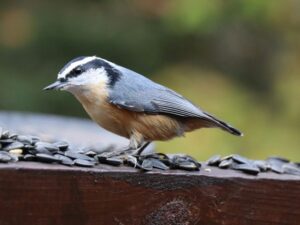
White-breasted nuthatches: They move headfirst down the tree trunks like little acrobats. Makes me smile every time.
-
Downy and hairy woodpeckers: They love the suet. Their steady tapping feels like someone knocking lightly at the back door.
-
Blue jays: Loud, flashy, full of personality. They make sure I know when they’ve arrived.
-
Dark-eyed juncos: They hop around in the snow under the feeder, flicking their tails, like they’re sweeping the ground.
There are others here and there — the occasional crow flying overhead, and every so often a cardinal that glows red against the snow like a Christmas ornament someone forgot to put away. I might not see a huge number of species on any one morning, but that’s not really the point. The regular visitors start to feel like neighbors you recognize, even if you don’t know their names perfectly.
A Few Visitors That Brighten the Snowy Days
If I had to pick a few that really lift my mood on those dark winter mornings, I’d say:
-
The chickadee that lands closest to me and seems to tilt its head as if it’s sizing me up.
-
The nuthatch that moves sideways and upside down on the pine trunk like gravity doesn’t exist.
-
The woodpecker that shows up right when I’m thinking of heading back inside, making me stay out just a minute longer.
Those little moments don’t sound like much, but at this stage of life they carry more weight than you might expect.
Making It Easy on an Older Body
I’ve learned that if this morning bird time is going to last, it has to work with my body, not against it. I don’t move as fast. My balance isn’t perfect. If I stay out too long without proper layers, I stiffen up.
So I’ve made a few choices that keep things gentle:
-
One good spot, instead of wandering. I used to think birdwatching meant walking through the park or hiking a trail. These days, I get plenty of joy from a single chair on the porch and a clear view of one part of the yard. The birds come to me.
-
Lightweight binoculars. I traded in my old heavy pair for a small set that fits my hands better. I can lift them without my shoulders complaining.
-
A comfortable chair. Not a folding camp chair that sags, but a sturdy one with a solid seat and back. My feet rest flat on the porch, and my knees don’t ache.
-
Short sessions. I treat this like a series of small visits, not one long one. Ten minutes after my first coffee, then maybe another five minutes mid-morning if the light looks nice.
One practical change that made a big difference was adding a small, non-slip mat right where I step out the door. Before that, I had a couple of close calls where the snow melted a bit in the afternoon and then froze again overnight. Now, when I step out with my mug in the gray light of a winter morning, I feel steadier. My mind can pay attention to the birds instead of worrying about my feet.
The result of all this is that my body doesn’t dread the routine. I don’t think, “Oh, that’s going to be a hassle.” It feels as easy as walking to the kitchen, turning on the coffee, and then stepping out for a breath of cold air and a few minutes of company from the birds.
How I Made This Work for My Own Backyard
You don’t need a big yard to do this. Mine is pretty small, just enough space for a few trees, a little patch of snow-covered grass, and a feeder pole near the porch. The houses on either side aren’t far away. I can sometimes hear my neighbors scraping ice off their windshields or letting their dogs out.
What helped me was treating my backyard like a little stage and my porch chair like the front row seat. I asked myself:
-
Where does the morning light hit first?
-
Where can I put a feeder so I can see it clearly without leaning?
-
Where do the birds already like to land — the pine tree, the fence, the old clothesline pole?
I ended up placing the main feeder where it’s framed by the pine branches behind it. That way, when the light finally comes up over the rooftops, the birds are lit from the side, and I can see their markings better. On some days, the sun breaks through just enough to turn the frost on the branches into little sparkles.
I also learned to accept whatever the day offers. Some mornings are quiet, with just a couple of chickadees and a nuthatch. Other mornings are busy, with jays flying in and out, arguing with each other like kids in a schoolyard. Either way, it still feels like time well spent.
I guess the main thing is that this small daily habit fits the size of my life now. It doesn’t ask me to be younger or stronger than I am. It meets me where I am — on a porch in Duluth, with a warm cup in my hand and a little more patience than I had when I was working full-time.
Why These Gentle Mornings Matter More to Me Now
At 68, I notice the quiet moments more. Not because life is perfect, but because I finally have some room to breathe. I’ve been through busy years, hard years, and those in-between years where you’re just trying to keep everything going. Now the days feel different. Slower, yes, but in a good way, if I let them.
These early winter mornings, standing or sitting on the porch, wrapped in my jacket with coffee warming my hands, give me a sense of being part of something steady. The chickadees and juncos don’t care about my age, or my aches, or what I used to do for a living. They just show up looking for seed and suet, doing what they’ve always done.
There’s comfort in that, especially up here where the winters are long and the light is scarce. Watching the birds right after that first mug of coffee helps set the tone for the rest of the day. It reminds me that I don’t have to rush, that noticing one small living thing in the cold is enough for a start.
If you’re retired, or just moving a little slower these days, you might find something similar in your own backyard or local park. You don’t need fancy equipment or a perfect knowledge of every species. All you really need is:
-
A warm drink
-
A safe, comfortable place to sit or stand
-
A simple feeder or two
-
A little willingness to pay attention
You might be surprised how much difference that makes. Even in the middle of a Duluth winter, with the wind coming in off Lake Superior and the sun taking its time to show up, those few gentle minutes with the birds can feel pretty nice.
If you ever feel like the days are too quiet now, or that you’re not sure how to fill the time after retirement, I’d say start small. Let yourself have that early-morning coffee, step outside for just a bit, and see who shows up in your backyard. It doesn’t have to be a big project. It can just be a soft, steady habit that keeps you company as the seasons turn and the years go by.